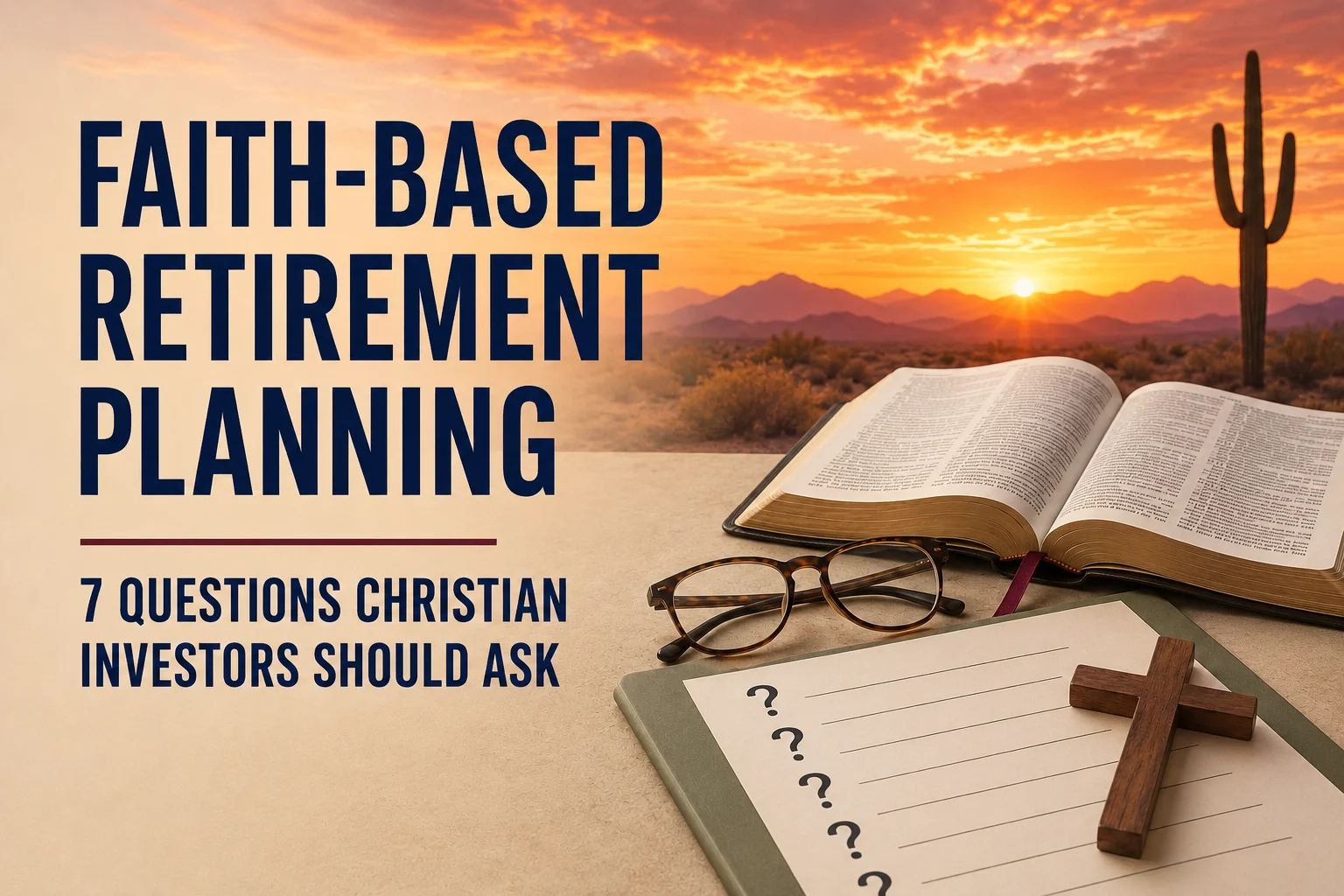
Faith-Based Retirement Planning in Phoenix: 7 Questions Christian Investors Should Ask Before Retiring
By Bonnie Clark
Retirement is often described as the reward for decades of hard work. But for a Christian, retirement can represent more than leaving a job or reaching a certain account balance. It can be a new season of stewardship, service, generosity, family, and purpose.
“Do I have enough?” still matters, but it is not the only consideration. You may also wonder whether your investments reflect your beliefs, how you will use your time, and what legacy you want to leave.
For Christians preparing to retire in Phoenix, Surprise, Peoria, Sun City, Goodyear, and throughout the West Valley, faith-based retirement planning brings those financial and spiritual priorities into the same conversation. It does not replace careful analysis. It adds your convictions and sense of purpose to decisions involving investments, income, Social Security, risk, giving, and legacy.
Here are seven important questions to consider before beginning this next chapter.
1. What Does a Faithful Retirement Look Like for Me?
Traditional retirement planning often begins with a target date and desired lifestyle. Faith-based planning begins one level deeper: What is this season of life for?
You may envision traveling, helping grandchildren, volunteering at church, mentoring younger people, supporting ministries, starting a small business, working part time or volunteering in a field that gives you joy, or caring for aging family members. Those choices affect how much income you need, where you live, how much flexibility your plan requires, and what resources you want available for others.
Retirement does not have to mean withdrawing from meaningful work. Scripture consistently presents our time, abilities, and possessions as things entrusted to us. Your role may change, but your calling to use what God has provided with wisdom and generosity does not end on your last day of employment.
2. Do My Investments Reflect My Christian Values?
Many investors spend years contributing to a 401(k), IRA, or other retirement account without examining the companies held inside their funds. A single mutual fund or exchange-traded fund may contain hundreds of securities. Some holdings may be connected to business activities that conflict with a Christian investor’s beliefs.
Biblically Responsible Investing, also called BRI, applies defined faith-based criteria to investment holdings. Depending on an investor’s convictions and the screening methodology, this may include identifying companies materially involved in abortion-related products or services, pornography, gambling, tobacco, marijuana or alcohol.
Screening should not be considered in isolation. Risk, diversification, costs, liquidity, taxes, and suitability continue to matter. Screening information is often supplied by third parties and can be incomplete, delayed, or interpreted differently. No process can guarantee perfect alignment.
The objective is not perfection. It is greater awareness and thoughtful decision-making. You can learn more in Biblically Responsible Investing Strategies in Arizona and What Is Values-Based Investing? A Christian Investor’s Guide.
3. How Much Investment Risk Is Appropriate as I Approach Retirement?
Approaching retirement often changes your relationship with investment risk. During your working years, you may have had time and employment income to help you recover from market declines. Once withdrawals begin, selling investments during a downturn can make recovery more difficult.
That does not automatically mean moving everything to cash. Retirement may last for decades, and an overly conservative portfolio can face inflation and longevity risk. The appropriate balance depends on withdrawals, reliable income, reserves, time horizon, health, and tolerance for market fluctuations.
A retirement-income plan should distinguish between money needed relatively soon and assets intended for later years or legacy goals. It should also be reviewed as markets and personal circumstances change. Diversification may help manage risk, but it cannot guarantee a profit or protect against loss.
4. How Will I Turn My Savings into Retirement Income?
Saving for retirement and living from retirement savings have different challenges. While working, the goal is generally accumulation. In retirement, the task becomes coordinating withdrawals with Social Security, pensions, cash reserves, and other income while considering taxes and market conditions.
Begin with expected expenses. Separate essential costs—housing, food, insurance, healthcare, and transportation—from flexible spending, and compare those needs with income that does not depend directly on market withdrawals.
Important questions include:
Which accounts should provide income first?
How much should remain readily accessible?
How will withdrawals respond to a significant market decline?
Which expenses may rise with inflation?
How might one spouse’s death change household income?
What resources are available if care needs increase later?
There is no universal withdrawal rate or account sequence for everyone. Retirement-account decisions can have tax consequences, so coordinate with a qualified tax professional.
5. When Should I Claim Social Security?
Social Security can be an important part of retirement income, and the decision about when to claim is not simply a break-even calculation. Health, longevity expectations, marital status, employment, survivor needs, other assets, and current cash flow can all affect the decision.
According to the Social Security Administration, as of October 2026, the Social Security Administration currently allows eligible workers to begin retirement benefits between ages 62 and 70. Starting before full retirement age generally produces a lower monthly benefit, while delaying beyond full retirement age can increase the monthly amount until age 70. You can review estimates through your personal my Social Security account.
https://www.ssa.gov/retirement/plan-for-retirement
For couples, claiming decisions should be evaluated together because survivor income may depend heavily on the larger benefit. Divorced and widowed individuals may also have options under Social Security rules. https://www.ssa.gov/survivor/eligibility
No adviser can “maximize” benefits in every possible future because lifespan and circumstances are unknown. The goal is to make an informed claiming decision that fits your broader retirement plan.
6. How Can Generosity Remain Part of My Retirement Plan?
Some Christians worry that retiring means they must stop giving or choose between generosity and financial security. Thoughtful planning can help you define a sustainable approach instead of leaving giving to chance.
Begin by identifying the people, churches, and ministries you most want to support. Decide whether giving will be a regular part of the household budget, an occasional gift when resources permit, or a longer-term legacy commitment. Your plan should also preserve adequate resources for your own needs so generosity does not create avoidable financial strain.
Charitable strategies can involve important tax and legal considerations. Consult appropriate tax and legal professionals before finalizing your plan. Rules and eligibility requirements can change, and a strategy should not be implemented solely because it produces a tax benefit.
Generosity is not measured only by dollars. Retirement may also create opportunities to offer time, experience, hospitality, prayer, leadership, or mentoring.
7. What Financial and Spiritual Legacy Do I Want to Leave?
Legacy planning is more than deciding who receives your accounts. It includes the values, wisdom, habits, and stories you pass to the next generation.
Start with the practical foundation. Review beneficiary designations, wills, powers of attorney, healthcare documents, account ownership, and trusted contacts. Beneficiary designations on retirement accounts and insurance contracts generally operate separately from a will, so inconsistent or outdated forms can create unintended outcomes. Work with a qualified estate-planning attorney for legal documents and advice.
Then consider the personal side. Do trusted family members understand the purpose behind your financial decisions? A family conversation or written legacy letter can communicate truths that account paperwork cannot.
Your investment choices can also form part of that legacy. A portfolio aligned with your convictions may help demonstrate that faith belongs in every area of life—including financial decisions. For more on that connection, read Faith-Driven Investing: Building a Portfolio with Impact.
A Hypothetical Phoenix Retirement Example
This is a hypothetical scenario for illustration purposes only. Individual results will vary.
Consider a hypothetical couple in the West Valley who expect to retire within three years. They have accumulated retirement accounts, expect Social Security benefits, give consistently to their church, and want more time for family and volunteer work.
Their review reveals several issues requiring discussion: their investments may carry more risk than they realized, their funds have not been evaluated under their preferred faith-based criteria, and they have not coordinated Social Security decisions or future withdrawals. Their beneficiary forms also need to be compared with their estate documents.
They develop a list of priorities and discuss alternatives with the appropriate financial, tax, and legal professionals. The resulting plan is not built around a promise or prediction. It is a coordinated framework for making decisions as retirement approaches.
This example is hypothetical and for illustrative purposes only. It does not describe an actual client, recommendation, performance result, or guaranteed outcome. Individual circumstances will vary.
Frequently Asked Questions
Is faith-based retirement planning only about investments?
No. Investments are one component. Faith-based planning may also consider retirement purpose, income, Social Security, generosity, family responsibilities, risk, healthcare, and legacy through the lens of the investor’s convictions.
Does Arizona tax Social Security benefits?
Arizona does not tax Social Security retirement benefits received under Title II, according to the Arizona Department of Revenue. Other retirement income may be taxable. Consult a qualified tax professional regarding your particular situation.
How early should I begin retirement planning?
Starting several years before retirement can provide more time to evaluate risk, savings, income sources, Social Security, taxes, insurance, and estate documents. However, it is never too late to become more organized and make informed decisions.
Bring Faith and Retirement Planning Into the Same Conversation
Retirement decisions are interconnected. A Social Security choice affects withdrawals. Withdrawals may affect taxes. Investment risk affects income reliability. Giving and legacy goals affect how much flexibility your plan needs. Your faith helps define the purpose behind all of them.
Kratos Wealth Management serves Christians in Phoenix, Surprise, Peoria, and throughout the West Valley who want financial guidance that considers both practical needs and deeply held values. Learn more about working with a Christian Financial Advisor in Phoenix or schedule a conversation with Bonnie Clark.
The goal is not to predict every future expense or market movement. It is to prepare thoughtfully, make informed decisions, and enter retirement with a plan connected to what matters most.
Compliance and Risk Disclosures: Investing involves risk, including the possible loss of principal. No investment strategy, including screened or values-aligned strategies, can guarantee performance or protect against loss. Screening criteria may limit investment options, reduce diversification, and cause performance to differ positively or negatively from broader market indexes. Incorporating a social objective or other nonfinancial objective into investment decisions will result in investment recommendations that are not focused on maximizing a financial return. Third-party screening information may be incomplete, delayed, or subject to differing interpretations. This material is for informational purposes only and does not constitute personalized investment, tax, legal, Social Security, or estate-planning advice.
Bonnie Clark offers Investment Advisory Services through Gradient Advisors, LLC (Arden Hills, MN 877-885-0508), an SEC Registered Investment Advisor. Gradient Advisors, LLC and its advisors do not render tax, legal, or accounting advice. Kratos Wealth Management is not a registered investment advisor and is not an affiliate of Gradient Advisors, LLC. Insurance products and services are offered through Bonnie Clark, independent agent.
Kratos Wealth Management, Bonnie Clark, and Gradient Advisors, LLC are not affiliated with or endorsed by the Social Security Administration or any government agency. All written content is for informational purposes only. Opinions expressed are solely those of Bonnie Clark. This article was prepared with the assistance of artificial intelligence tools and was reviewed, edited, and approved by Bonnie Clark. The presence of this website shall in no way be construed or interpreted as a solicitation to sell or offer to sell Investment Advisory Services to residents of any state other than the state(s) Bonnie Clark is registered in or where otherwise legally permitted. Material presented is believed to be from reliable sources; however, no representation is made as to its accuracy or completeness. All information and ideas should be discussed in detail with your individual adviser before implementation.